In this YouTube video, I like the list where it shows ways that you should and should not want to use technology in the classroom. Here is a list of some of the shoulds:
+ Make Prezis
+ Start Blogs
+Create Wordles
And here are some of the should nots:
+ Raise Awareness
+ Start Conversations
+ Find Answers (To Their Questions)
This is the kicker to me:
What's important here is... the level of student engagement in LEARNING, not the tool.
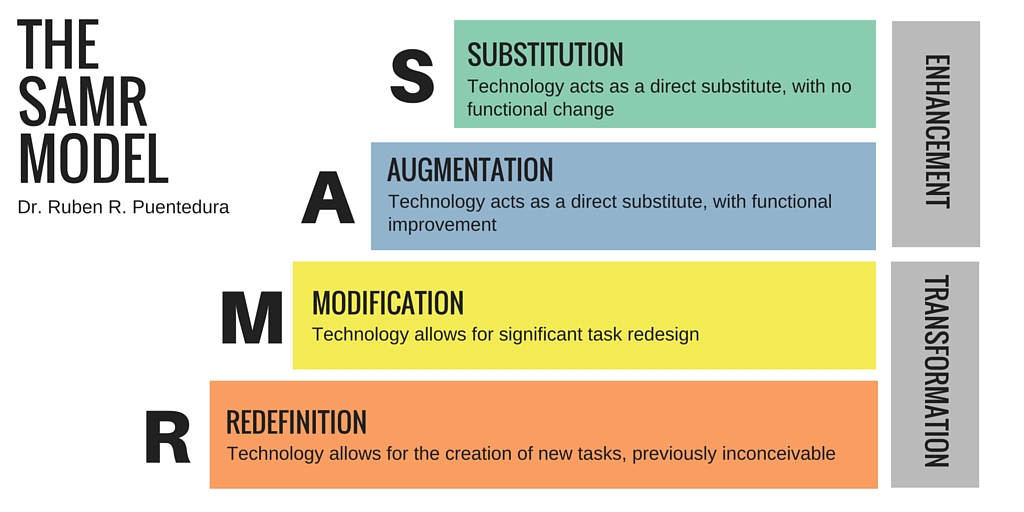 There have been times where I think a tool is so fun and exciting, and oh, wouldn't that be engaging for my students... It might be fun and exciting and engaging, but how does it engage them in learning? This is the heart of integrating with intention; finding tools that substitute, augment, modify, and redefine the process to enhance and transform learning. We have to use tools to serve a specific purpose which improves learning, and, therefore, warrants the time spent teaching the tool.
2. Which analogy for the SAMR model do you find most helpful? Explain why.
I like this Starbucks analogy, seems appropriate since we are in Washington:

This is helpful to me because it shows the enhancement or transformation of each drink. The images in question #1 and question #3 are more helpful for my overall understanding of SAMR. The scuba diver analogy is equally as helpful as the Starbucks, but I like that the Starbucks drinks are all coffee-based drinks. There's quite the jump to compare a snorkel and a submarine.
3. Which level of SAMR can you see yourself using most? Explain why.
 I think it's safe to say that I will use substitution the most as it is something I do frequently already. Last year I taught in a classroom where we had a classroom set of Chromebooks, which I know you all know, and this coming year I will be again (yes!). We provided online texts all the time because we were able to share primary sources and secondary sources and include a variety of texts to enhance their learning. Augmentation occurred often as well as we shared documents via the Google Suite and students engaged in many online tasks. I think we even did some modification and redefinition especially in a unit where the summative assessment was a public service announcement. Without the tools, this project would not have been possible.
Gosh, I really liked the video you posted. What a cool way to introduce and clarify the topic of your blog. I love what you said about finding tools that are super fun and exciting and then taking a step back and thinking, how is this benefiting the learning process. I have found myself doing the exact same thing. Something is fun and interesting,but it won't really get at the root of what we are trying to accomplish. The idea of being intentional seems to be at the heart of SAMR. I also like what you had to say about the Google Suite, they are really useful online tools that are free and engaging. Thanks! Great read.
ReplyDeleteThanks Jane! I think we have to find tools that work for us as teachers and not just what someone else suggests. It's a challenge because there are so many cool apps out there that seem like they would be perfect to use in the classroom, but we have to master them first. And you know how much free time we have to learn new apps... ;)
DeleteI agree with Jane! I loved what you said about being intentional with the integration of technology and how it will enhance and transform learning. For me and in my first grade experience, by providing additional tools, you may be allowing some students to make connections with the curriculum that they hadn't had yet. Its like technology differentiation. I mentioned in the first blog how I am a visual/kinesthetic learner, and I think given the right technology tools I could connect with learning that provides that more than other traditional methods of learning. Thanks for sharing your thoughts!
ReplyDeleteTechnology differentiation, I love that! I had a student this year who had terrible dyslexia and could barely write, his typing was much better, but when we could, he used a talk-to-text program and he was so much more successful. Technology definitely gives us so many methods of reaching out to all the different learning styles in our classes!
DeleteMichelle. It is great that you were able to have access to technology in your classroom. It sounds like students benefited immensely from the chrome books. Do you think there are way in which you might be able to "transform" your future class using technology where you are completely redefining the way in which you teach and they learn?
ReplyDeletePossibly, although, I still prefer to have some activities/assignments done on paper and pencil. For example, personally, I prefer to read longer articles on paper especially for annotation purposes, and it seems like my students have deeper comprehension when we read a paper copy and underline/highlight/take notes as opposed to using an online tool for that. I can definitely find new ways to modify and redefine assignments to get to that transformative place.
Delete